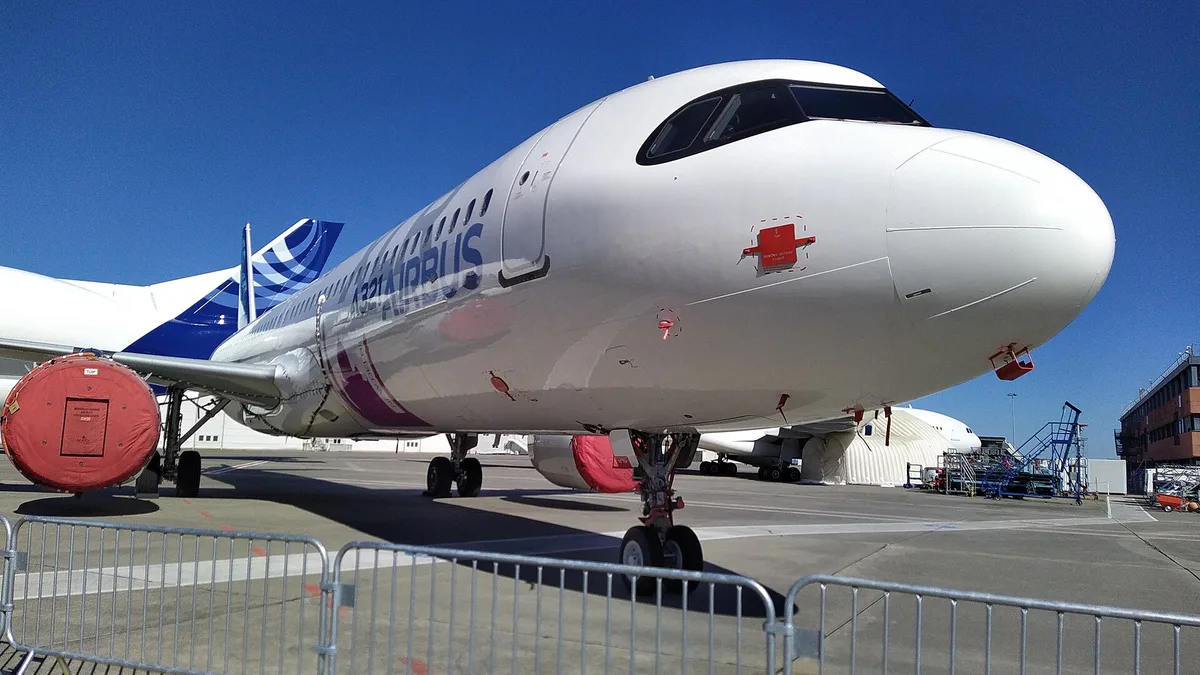
A321Xlr
| Country of origin | Multinational (European consortium) |
|---|---|
| First created | 2010s (programme launched 2018) |
| Original use | Long-range, high-capacity narrow-body airliner |
| Manufacturer | Airbus |
| Aircraft family | Airbus A320neo family |
| Typical seating | 180 to 220 (two-class) |
| Range | Approximately 4,700 nautical miles (8,700 km) |
| Engines | Two high-bypass turbofans (e.g., Pratt & Whitney PW1100G or CFM International LEAP-1A) |
Origin and history
The Airbus A321XLR is a derivative of the Airbus A320neo family, originating from the European multinational aerospace corporation Airbus. Its development was formally launched in the late 2010s, with the program publicly announced at the Paris Air Show in 2019. The aircraft represents the latest and longest-range variant in the A320neo series, which itself is an evolution of the original A320 family first introduced in the 1980s. This lineage places its conceptual and industrial roots firmly in Western Europe, primarily across France, Germany, the United Kingdom, and Spain. The XLR (Extra Long Range) designation follows the earlier LR (Long Range) variant, continuing a strategic focus on expanding the capabilities of the single-aisle aircraft category. Its development history is part of Airbus's ongoing strategy to address airline demands for greater range and efficiency from a narrowbody platform.
What it is designed for
The A321XLR is specifically engineered to serve long-haul, thin routes that were previously only economically viable for larger, less efficient twin-aisle aircraft. Its core design mission is to enable non-stop flights of up to approximately 4,700 nautical miles, effectively connecting city pairs like London to New Delhi or Boston to Rome. The aircraft is intended to allow airlines to open new point-to-point routes between secondary cities, bypassing congested major hubs. It is designed to carry between 180 and 220 passengers in a typical two-class configuration over these extended distances with lower operating costs per seat than a widebody. The design directly targets a market segment often referred to as the "middle of the market," where passenger demand exists but not at volumes sufficient for larger jets. Furthermore, it is crafted to compete directly with Boeing's proposed New Midsize Airplane (NMA) and to capitalize on the trend of long-haul narrowbody operations.
Development and versions
Development of the A321XLR centers on significant modifications to the baseline A321neo airframe and systems to achieve its extended range. The most critical change is the installation of a new, permanent Rear Centre Tank (RCT) integrated into the aircraft's lower fuselage, which provides a significant fuel capacity increase over the removable auxiliary tanks used on the LR variant. This structural integration allows for higher fuel volume while preserving cargo hold space and maintaining common type rating with the rest of the A320neo family. Other key developments include strengthened landing gear to handle the increased maximum takeoff weight and aerodynamic optimizations. As of its development phase, the A321XLR is a single version model, though it is offered with a choice of engines from Pratt & Whitney (PW1100G) or CFM International (LEAP-1A). The programme achieved its first flight in the early 2020s and was undergoing certification and testing, with entry into service targeted for the mid-2020s.
Pros and cons
A primary advantage of the A321XLR is its ability to unlock new long, thin routes with superior per-seat economics compared to larger widebody aircraft, potentially boosting airline profitability on these segments. Its commonality with the vast A320neo family offers significant cost savings in pilot training, maintenance, and spare parts logistics for existing operators. However, a genuine drawback is the compromise in passenger comfort on the longest sectors, as the single-aisle cabin can feel confined during flights exceeding eight or nine hours, especially for passengers in standard economy seats. Airlines may regret choosing it for routes where demand quickly grows beyond its capacity, as it lacks the scalability of a widebody and faces frequency constraints at slot-controlled airports. A common mistake in its deployment would be scheduling it on routes with strong premium demand, as its business class cabin options are physically limited by the narrow fuselage diameter. Furthermore, its high utilization requirement to justify its capital cost means it is poorly suited for seasonal or irregular route patterns.
Who it suits
The A321XLR best suits network airlines looking to efficiently serve long-haul, point-to-point routes between secondary cities or to add frequency on thinner long-haul routes from their primary hubs. It is particularly advantageous for airlines with large existing A320neo family fleets, as they can integrate the type with minimal additional operational overhead. Low-cost carriers with aspirations to expand into longer-haul markets may also find it appealing due to its cost-efficient single-aisle operating model. The aircraft suits markets where passenger demand is consistent but insufficient to daily fill a larger 250-300 seat widebody aircraft, allowing for daily or near-daily service. It is less suited for flag carriers whose brand is built on spacious widebody comfort on all long-haul flights or for airlines operating primarily from hub airports with no slot constraints where larger aircraft can be used freely. Ultimately, it is a tool for route network planners seeking to exploit specific gaps in the market with a highly efficient asset.