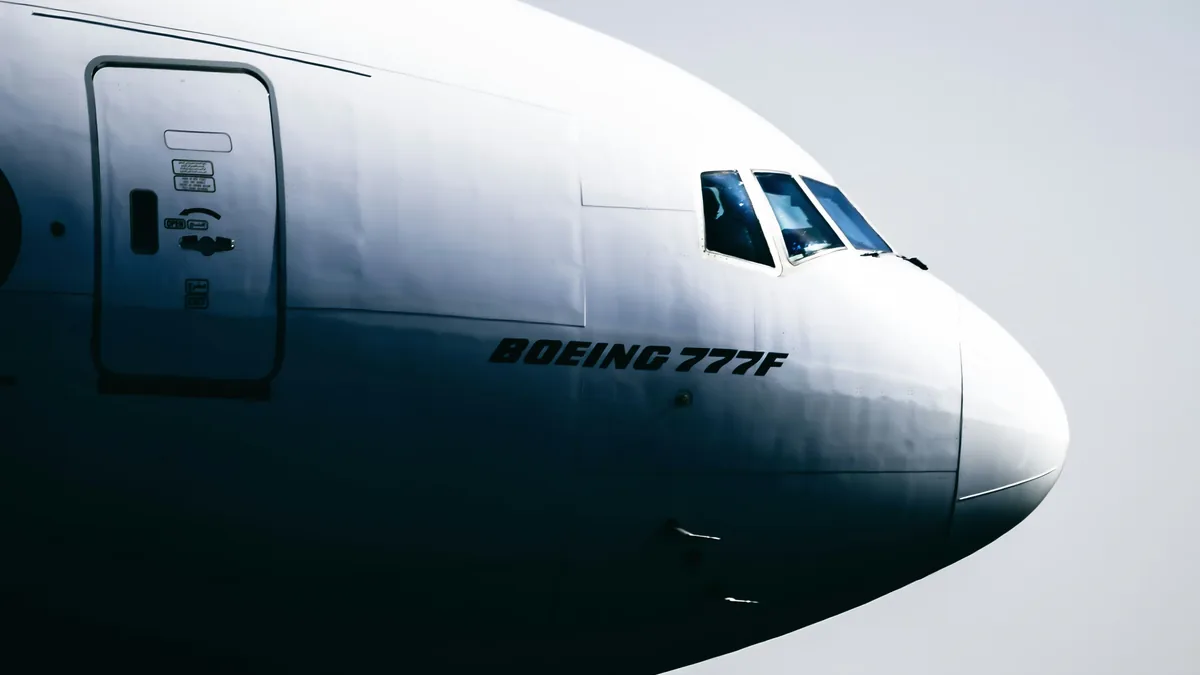
777F
| Country of origin | United States |
|---|---|
| First created | 1990s |
| Original use | Cargo transport |
| Manufacturer | Boeing |
| Role | Freighter aircraft |
| Cargo capacity | High (over 100 metric tonnes) |
| Range | Long-haul (intercontinental) |
| Engine type | High-bypass turbofan (typically GE90 or PW4000 series) |
| Wing design | Low-wing, swept |
Origin and history
The Boeing 777 Freighter, commonly designated 777F, originates from the United States and is a derivative of the highly successful Boeing 777 passenger airliner. Its development was launched in the mid-2000s to address a growing market demand for a large, efficient, and long-range cargo aircraft. The program was formally announced by Boeing in 2005, with the launch customer being Air France. The design leveraged the existing 777-200LR (Longer Range) airframe, which provided an ideal platform for conversion due to its structural strength and impressive range capabilities. The first 777F aircraft made its maiden flight in 2008, and the type entered service with Air France in 2009. Its development capitalized on over a decade of operational experience with the 777 passenger variants, ensuring a mature and reliable base platform for the freighter conversion.
What it is designed for
The 777F is designed as a dedicated freighter aircraft to serve the long-haul air cargo market, replacing older quad-engine freighters like the Boeing 747-400F and the McDonnell Douglas MD-11F. Its primary design mission is to transport high-density cargo over extreme distances without the need for intermediate technical stops, thereby optimizing global supply chains. The aircraft is engineered to carry standard industry pallets and containers in its lower holds and on its main deck, maximizing cubic capacity and operational flexibility for integrators and combination carriers. A key design focus was achieving a lower ton-mile cost compared to preceding aircraft, which is accomplished through its twin-engine efficiency and high structural payload capability. It is specifically tailored for routes connecting major industrial and commercial hubs across continents, such as between Asia, Europe, and North America. The design also incorporates a large side cargo door and a powered cargo handling system to facilitate rapid turnarounds on the ground, which is critical for cargo operations.
Development and versions
The 777F was developed as a purpose-built freighter variant, distinct from a passenger-to-freighter conversion, though it shares its basic airframe with the 777-200LR. The development process involved strengthening the main deck floor, installing a rigid cargo barrier wall behind the cockpit, and integrating a cargo handling system and a large main deck cargo door. There is only one factory-produced version of the 777F, which has remained consistent in its core specifications since its introduction. However, Boeing has offered performance enhancement packages over the years, such as increased maximum takeoff weight (MTOW) options, allowing operators to carry more payload over very long ranges. The aircraft's systems and engines have benefited from continuous product improvements developed for the broader 777 family. It is important to distinguish the factory-built 777F from aftermarket passenger-to-freighter conversion programs for older 777-200ER aircraft, which are separate initiatives by third-party companies and not considered original versions of the 777F.
777F specs
The 777F is powered exclusively by two high-thrust turbofan engines, either the General Electric GE90-110B1 or the GE90-115B, which are among the most powerful jet engines ever built. Its typical maximum structural payload is approximately 102 metric tons, which can be carried within its main deck and lower hold containerized cargo compartments. Its range with a full payload is in excess of 9,000 kilometers, enabling non-stop flights between most major international cargo hubs. The fuselage is of constant cross-section, providing a main deck cargo volume of nearly 636 cubic meters, which is optimized for loading industry-standard 96x125-inch pallets. The aircraft's maximum takeoff weight is typically around 347 metric tons, depending on the specific customer-selected configuration and any subsequent weight increase packages.
Overview
The Boeing 777F is a twin-engine, wide-body freighter that represents a significant step in the evolution of long-haul air cargo transport. It combines the aerodynamic efficiency and advanced systems of the 777 passenger family with a robust cargo-specific structure and layout. The aircraft is a common sight at major cargo airports worldwide, operated by dedicated freight airlines, combination carriers, and integrated express parcel operators. Its operational profile is characterized by very long stage lengths, often exceeding 15 hours of flight time when fully loaded, which allows for direct point-to-point operations across oceans and continents. The cockpit and flight management systems are common with other 777 variants, allowing for pilot commonality and reduced training costs for airlines that operate mixed fleets. Its introduction has steadily driven the retirement of older, less efficient quad-engine freighters, establishing it as a backbone of modern global air cargo networks.
What to know
The 777F's operating economics are heavily dependent on high load factors due to its significant capital cost and the need to utilize its large capacity to achieve lower ton-mile costs. Its dispatch reliability is generally very high, benefiting from the mature 777 platform, though maintenance events for its massive GE90 engines are major undertakings with substantial cost implications. The aircraft's landing gear and brakes are designed to handle frequent high-weight landings, but these components require rigorous and scheduled maintenance to manage wear. While designed for long hauls, it is also routinely used on shorter, high-density regional routes in Asia, where its capacity is fully utilized despite the shorter stage length. A key operational consideration is the balance between payload and range; operators must carefully plan missions to optimize the trade-off, as taking maximum payload reduces available fuel and thus range. The aircraft has no production competitor in its exact size and range category, though it faces competition from the Airbus A350F, which is a newer design offering different efficiency propositions.
Common questions
A common question is how the 777F differs from a converted passenger 777, with the answer being that the 777F is a stronger, purpose-built factory freighter with a higher payload and a cargo door designed during initial manufacturing. Operators often inquire about engine choice, but the 777F has only ever been offered with GE90 engines, providing no option for other engine manufacturers like Pratt & Whitney or Rolls-Royce on this variant. Many ask about its replacement for the Boeing 747 freighter, and while it carries less volume and payload than a 747-8F, it does so with two engines instead of four, leading to superior fuel efficiency on many routes. A frequent technical question concerns its cargo door location, which is on the forward left side of the fuselage, a standard placement that facilitates straight-in loading of the main deck. People also ask about its crew requirements, which typically consist of two pilots, mirroring the operational crew of passenger 777s, with no need for a flight engineer. Another routine question is about its ability to carry outsize cargo, and while it can handle most standard palletized goods, its door size and fuselage diameter limit it compared to the nose-loading 747 freighter.
Pros and cons
A significant pro is its exceptional fuel efficiency per ton-mile compared to older generation quad-engine freighters, which directly lowers operating costs on long-haul routes. The aircraft also boasts very high dispatch reliability and a global support network, minimizing unexpected downtime for cargo operators. A major con is its high capital acquisition cost, which can be a barrier to entry for smaller cargo airlines and necessitates very high utilization to justify the investment. The common mistake for operators is deploying it on routes with insufficient cargo density or demand, leading to frequent flights with low load factors that erase its economic advantages. Some operators regret choosing it for primarily regional operations where its long-range design and associated systems are not fully utilized, and a smaller freighter would be more cost-effective. Another genuine drawback is its limited volume-to-weight ratio for very low-density cargo, where its structural payload limit is reached before the cargo hold is physically full, which can be an issue on certain trade lanes.
Who it suits
The 777F ideally suits large integrated express carriers like FedEx and UPS, which require predictable, high-capacity lift on dense global trunk routes to feed their network hubs. It is also well-suited for combination carriers, such as Lufthansa or Air Canada, that operate mixed passenger and cargo fleets and can leverage pilot and maintenance commonality with their passenger 777 aircraft. Major dedicated cargo airlines like Qatar Airways Cargo and Emirates SkyCargo are prime operators, as they focus on connecting major international hubs with consistent high-yield freight. The aircraft suits operators with established long-haul routes where demand consistently justifies its large capacity and where its range enables non-stop service over competitive one-stop alternatives. It is less suited for new entrants or small cargo airlines without the capital, route network, or guaranteed volume to keep the aircraft productively employed. Finally, it suits operators looking for a modern, efficient freighter to replace aging MD-11F or 747-400F aircraft while avoiding the even higher cost and complexity of the newer 747-8F.