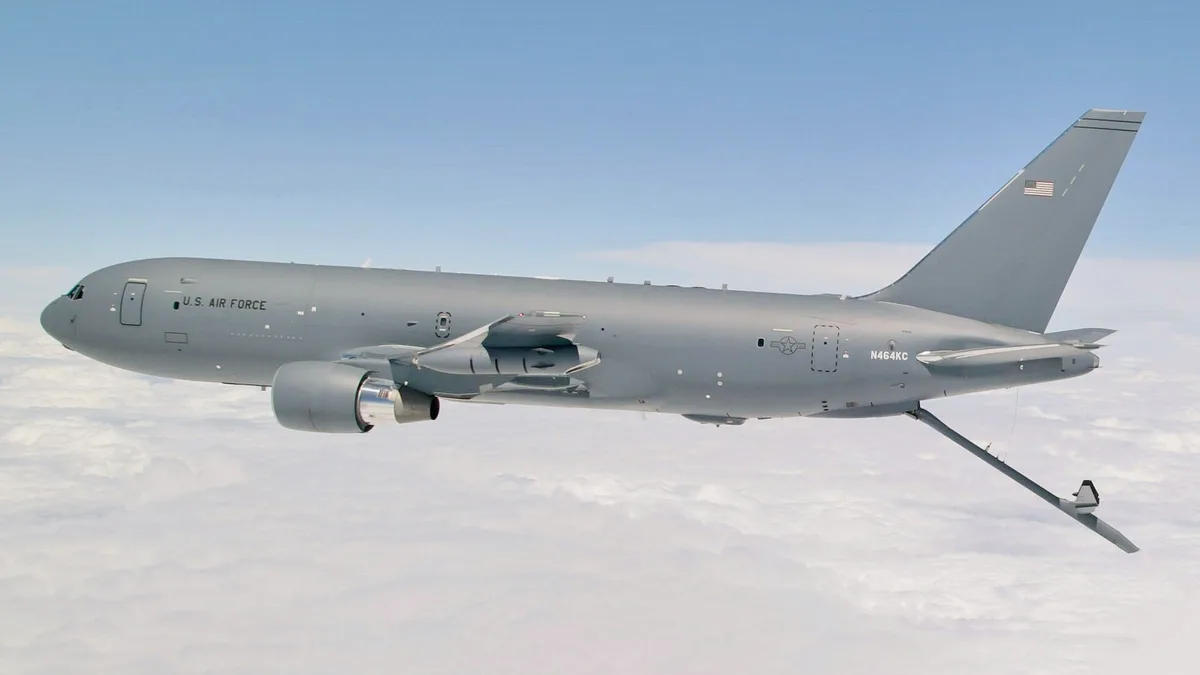
Kc 46A
| Manufacturer | Boeing |
|---|---|
| Country of origin | United States |
| Original use | Aerial refueling and strategic airlift |
| First flight | 2015 |
| Airframe derivative | Boeing 767-2C |
| Primary engines | 2 × Pratt & Whitney PW4062 |
| Role | Multi-role tanker/transport |
| Operators | United States Air Force |
Origin and history
The KC-46A Pegasus is a military aerial refueling and strategic transport aircraft developed in the United States. Its development was initiated in the early 21st century to replace the aging KC-135 Stratotanker fleet. The aircraft is derived from the commercial Boeing 767-200ER airframe, a platform selected for its proven reliability and efficiency. The program originated from the U.S. Air Force's KC-X competition, which was a prolonged and contested acquisition process. Boeing was officially awarded the contract to develop the KC-46A in the 2010s. This program represents a continuation of the long-standing practice of adapting commercial jetliners for specialized military tanker duties.
What it is designed for
The KC-46A is primarily designed for aerial refueling of U.S. and allied military aircraft using both a flying boom and hose-and-drogue systems. Its secondary mission is to provide strategic airlift capability for cargo, passengers, and aeromedical evacuation. The aircraft is engineered to operate globally in contested or permissive environments, requiring defensive systems for crew and aircraft protection. It is equipped with a Remote Vision System (RVS) that allows the boom operator to guide refueling operations from a station in the forward cabin using camera displays. The design incorporates hardened cybersecurity measures and electromagnetic pulse protection for mission resilience. The airframe's large fuel capacity and range are intended to extend the reach and endurance of fighter, bomber, and mobility aircraft.
Development and versions
Development of the KC-46A has been marked by significant technical challenges and cost overruns beyond initial projections. Critical issues emerged with its Remote Vision System, which presented depth perception problems for boom operators under certain lighting conditions, requiring a major redesign. Further deficiencies were identified in the aircraft's cargo locking system and its centerline drogue system, which experienced uncommanded disconnects during refueling. As of the early 2020s, the KC-46A exists in a single baseline production version, with ongoing incremental upgrades delivered in lots. These upgrades focus on correcting deficiencies, improving the RVS, and adding new capabilities like communications networking. The development process has involved rigorous testing and modification, with the aircraft undergoing operational testing and evaluation while simultaneously conducting production and fielding.
Pros and cons
A primary advantage of the KC-46A is its modern airframe, which offers greater fuel offload capacity, improved range, and enhanced reliability compared to the legacy KC-135. It provides strategic flexibility through its dual-role capability as both a tanker and a transport aircraft. The aircraft's advanced defensive systems and cockpit avionics offer improved survivability and situational awareness over previous tanker generations. A significant con is the persistent technical flaws in its core refueling systems, particularly the Remote Vision System, which has limited its full operational capability for years. Operators regret the aircraft's initial lack of readiness, as it entered service with multiple Category 1 deficiencies that restricted its use with certain receiver aircraft. A common mistake is underestimating the sustained logistical and maintenance support required to integrate such a complex new platform, which has strained operational units during its initial fielding.
Who it suits
The KC-46A suits the U.S. Air Force's Air Mobility Command, which requires a modern multi-role tanker to support global power projection and sustainment operations. It is suited for missions requiring simultaneous cargo or passenger transport alongside aerial refueling, maximizing airframe utility. The aircraft suits allied nations participating in cooperative security agreements, as its boom and drogue systems are compatible with a wide array of NATO and partner aircraft. It is appropriate for operations where a degree of threat awareness is necessary, given its integrated defensive suite. The platform suits long-endurance missions where crew comfort and reduced fatigue are factors, due to its larger cabin and modern amenities compared to older tankers. It does not suit operators seeking a low-cost or immediately fully capable solution, as the program has involved substantial investment and a protracted resolution of technical issues.