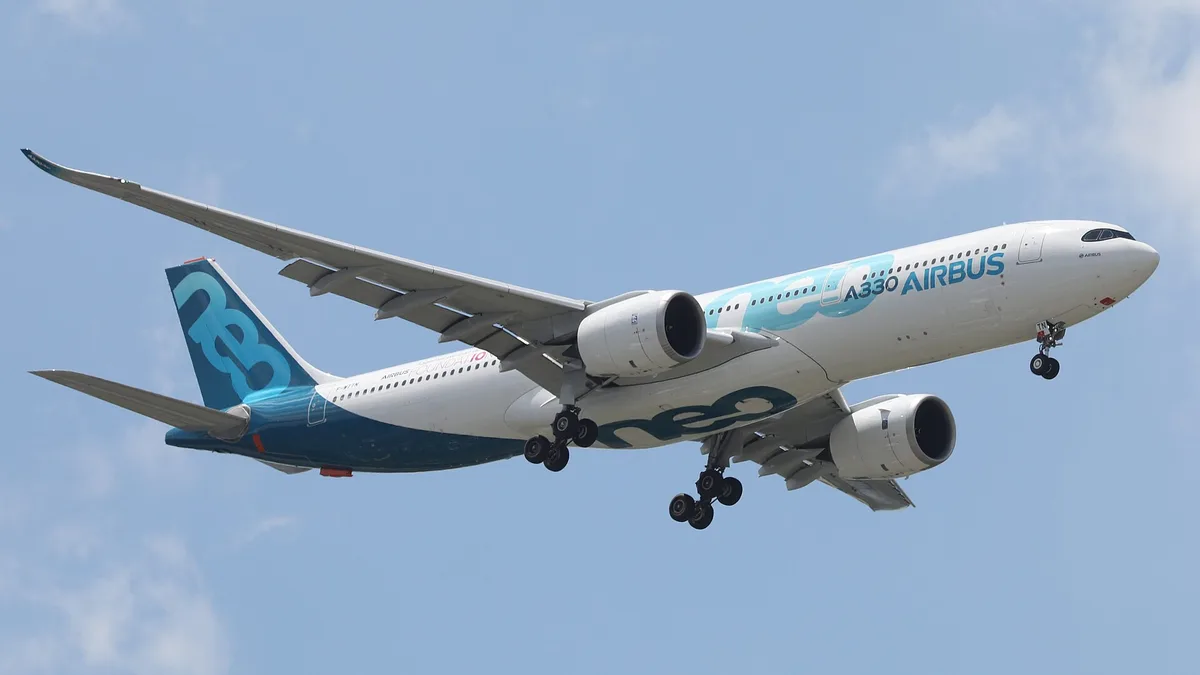
A330Neo
| Manufacturer | Airbus |
|---|---|
| Original use | Long-haul passenger airliner |
| First flight | 2016 |
| Engines | Two Rolls-Royce Trent 7000 or General Electric GEnx-1B (variant-specific) |
| Typical seating (two-class) | 260 to 300 |
| Maximum range | 6,550 to 7,200 nautical miles (variant-specific) |
| Wingspan | 64 metres |
Origin and history
The Airbus A330Neo (New Engine Option) is a wide-body twinjet airliner developed by the European aerospace manufacturer Airbus. Its origin lies in the long-running A330 family, which was originally launched in the late 1980s. The A330Neo programme itself was formally launched in the mid-2010s as a strategic response to newer competitor aircraft. This development was a direct derivative effort, intended to modernize the existing A330 platform rather than create an entirely new airframe. The programme leveraged decades of operational experience and a vast existing fleet to reduce development risk and cost. Its history is fundamentally one of evolution, applying new technology to a proven design to extend its production life and market relevance.
What it is designed for
The A330Neo is designed primarily for medium-to-long-haul route operations, filling a capacity niche between smaller narrow-body jets and the largest wide-body aircraft. It is engineered to offer lower operating costs per seat compared to its predecessor, the A330ceo (Current Engine Option), through significant fuel efficiency gains. The aircraft targets airline requirements for routes with high passenger demand that do not justify the largest twin-aisle jets like the A350 or Boeing 777. A key design focus is operational flexibility, allowing airlines to deploy it efficiently on both regional and transcontinental sectors. It is also intended to serve as a comfortable and modern platform for passengers, with cabin amenities derived from newer Airbus models. The design specifically aims to provide a cost-effective bridge for airlines transitioning from older-generation wide-bodies to the latest generation of composite-intensive aircraft.
Development and versions
Development of the A330Neo centred on integrating new-generation Rolls-Royce Trent 7000 engines and incorporating aerodynamic refinements from the Airbus A350 programme. The major changes include new composite Sharklet wingtips, which are larger than the previous wingtip fences, and a re-designed wing leading edge for improved aerodynamics. The cabin features an updated "Airspace" interior, offering larger overhead bins, enhanced lighting, and the potential for higher-density configurations. There are two main versions: the A330-800 and the larger, more popular A330-900, which is a direct replacement for the A330-300. The A330-800, a replacement for the A330-200, has seen very limited sales, making the -900 the de facto standard variant for the Neo family. The development programme faced challenges, including engine delivery delays that impacted initial entry-into-service schedules and customer deliveries.
A330Neo specs
The A330Neo specifications highlight its role as a modern, efficient wide-body. The A330-900 typically accommodates around 260 to 300 passengers in a standard three-class layout, with a maximum certified capacity often exceeding 400 in high-density configurations. Its wingspan is increased compared to the A330ceo, primarily due to the new Sharklets, which measure over 64 meters. The aircraft is powered exclusively by two Rolls-Royce Trent 7000 turbofan engines, each delivering approximately 68,000 to 72,000 pounds of thrust. The maximum take-off weight (MTOW) for the -900 is in the range of 251 tonnes, allowing for significant payload and range flexibility. The typical range for the A330-900 is established as roughly 7,200 nautical miles, enabling it to operate routes such as London to Singapore or Tokyo to Sydney.
A330Neo seat map
A typical A330Neo seat map for the A330-900 variant features a standard twin-aisle, eight-abreast economy class configuration, commonly arranged as 2-4-2. Business class is typically located in the forward cabin and is often arranged in a 1-2-1 layout, granting all passengers direct aisle access. Premium economy cabins, where installed, are usually placed between business and economy, in a 2-3-2 or 2-4-2 layout with increased seat pitch and width. The "Airspace" cabin allows for various configurations, with some airlines opting for high-density layouts of up to 440 seats in a single-class setup for charter operations. Galley and lavatory positions are strategically placed to facilitate efficient service during long flights and to maximize revenue-generating floor space. The seat map is highly customizable for airlines, reflecting the aircraft's role as a flexible platform for diverse business models.
Overview
The Airbus A330Neo represents the culmination of incremental innovation applied to one of the industry's most successful wide-body airframes. The programme's success is heavily reliant on the performance and reliability of its new engine partnership with Rolls-Royce, which promises double-digit percentage improvements in fuel burn per seat. Operationally, it benefits from a high degree of commonality with the previous A330 models, allowing for simplified pilot training and maintenance procedures for existing operators. Its market position is defined by offering a lower-risk, lower-acquisition-cost alternative to all-new composite aircraft while delivering a significant portion of their efficiency benefits. The aircraft serves as a critical product for Airbus, ensuring the A330 production line remains active and competitive against rival offerings like the Boeing 787.
What to know
Prospective operators and observers should know that the A330Neo's economics are critically dependent on the Trent 7000 engine's performance and maintenance costs, which are still being fully realized across the fleet. The aircraft's residual value and long-term market appeal are subjects of industry debate, given it is a derivative design competing against clean-sheet competitors. Its commonality with the A330ceo is a double-edged sword, offering cost savings but also meaning it carries over certain aerodynamic and systems architecture limitations from the 1990s. The A330-800 variant is commercially niche, with very few orders, meaning the programme is effectively the A330-900. Airlines have praised the passenger experience offered by the Airspace cabin, particularly the perceived spaciousness and improved ambience. It is essential to understand that the aircraft is a strategic tool for network carriers to efficiently up-gauge routes and for leisure airlines to achieve low seat-mile costs on dense, long-haul holiday routes.
Common questions
A common question is how the A330Neo differs from the Boeing 787, with the key distinction being the Airbus jet's metal fuselage versus the Boeing's composite structure and its derivative versus clean-sheet design philosophy. Many ask about the difference between the A330-800 and -900, which is primarily passenger capacity and range, with the -800 being slightly longer-legged but much less popular. Passengers frequently inquire if the A330Neo is quieter than older aircraft, and it is, due to its advanced engines and improved aerodynamic features. Industry analysts often question its long-term fuel efficiency relative to newer designs, as incremental gains may be outpaced by next-generation technologies over its multi-decade service life. A recurring operational question concerns pilot type ratings, and pilots rated on the A330ceo can transition to the Neo with differences training, not a full new type rating. Another frequent query is about its freight capability, and like its predecessor, it retains a significant lower-hold cargo volume, making it attractive for combination passenger-cargo operations.
Pros and cons
Pros: The A330Neo offers lower operating costs per seat than its predecessor, primarily through a ~14% fuel burn improvement. It provides excellent cabin comfort with the modern Airspace interior, which is a strong selling point for passenger-focused airlines. The high degree of commonality with the vast A330ceo fleet reduces training and maintenance overhead for existing operators. It has strong payload-range performance on dense regional and medium-long-haul routes, often outperforming projections for its stage lengths. The aircraft is available with shorter lead times and at a lower purchase price than its all-new composite competitors, making it financially accessible. Cons: The aircraft is derivative, inheriting aerodynamic and systems architecture limitations that may cap future efficiency gains compared to clean-sheet designs. Its reliance on a single engine manufacturer (Rolls-Royce) creates dependency and risk, as evidenced by early technical delays and ongoing reliability scrutiny. The resale value is a concern for lessors and airlines, as the market may ultimately value newer-generation aircraft more highly over the long term. The A330-800 variant has been a commercial failure, calling into question the family's flexibility and splitting development focus. Some airlines regret its selection where ultra-long-range or maximum efficiency on the longest thin routes is required, a role better filled by the A350 or 787. A common mistake is viewing it solely as an A330 replacement rather than a strategic asset that must compete against the 787's lighter weight and advanced systems.
Who it suits
The A330Neo suits established A330ceo operators looking to modernize their fleets with minimal operational disruption and capital outlay. It is well-suited to full-service network carriers that need a efficient, comfortable aircraft for high-demand medium-haul routes, such as within Asia or across the North Atlantic. Leisure and charter airlines are a key demographic, as they can exploit its high-density seating capability and lower seat-mile costs for package holiday routes. Airlines with strong cargo operations benefit from its generous underfloor cargo holds, making it ideal for mixed passenger-freight missions on key trade lanes. It also suits airlines that prioritize passenger cabin experience and commonality over having the absolute lowest weight or most advanced systems architecture. Finally, it is a pragmatic choice for airlines that are risk-averse to the teething problems of all-new aircraft types and prefer the known quantities of an evolved design.