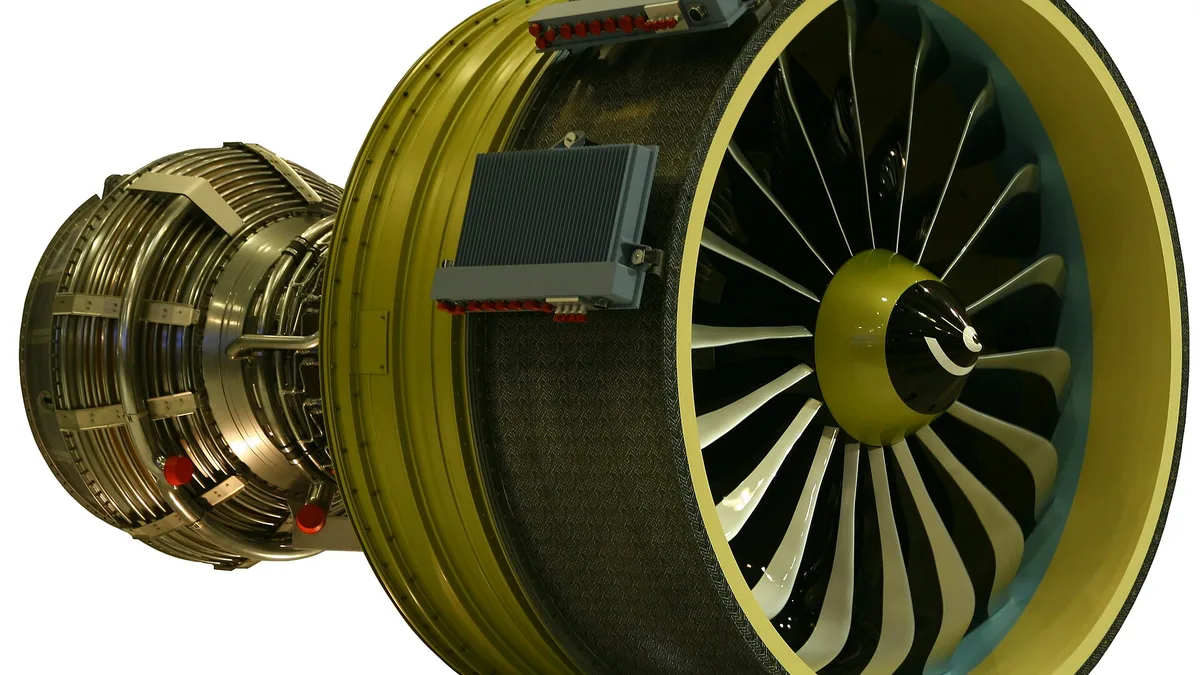
Cfm Leap 1A
| Manufacturer | CFM International |
|---|---|
| Original use | Commercial aviation (narrow-body aircraft) |
| Country of origin | Joint venture between GE Aerospace (USA) and Safran Aircraft Engines (France) |
| First flight | 2013 (on Airbus A320neo prototype) |
| Thrust range | 24,500 to 35,000 lbf |
| Bypass ratio | Approximately 11:1 |
| Programme status | In production and service |
Origin and history
The CFM International LEAP-1A is a high-bypass turbofan engine originating from a joint venture between American company GE Aerospace and French company Safran Aircraft Engines. This collaboration, named CFM International, was established in the 1970s. The LEAP engine family, including the -1A model, was launched in the 2000s as a next-generation successor to the highly successful CFM56 series. Its development was a direct response to airline demands for greater fuel efficiency and reduced emissions. The LEAP-1A entered service in the 2010s, marking a significant technological leap for the single-aisle aircraft market. Its design incorporates decades of operational experience from thousands of CFM56 engines in service worldwide.
What it is designed for
The LEAP-1A is designed exclusively as the sole engine option for the Airbus A320neo family of aircraft, which includes the A319neo, A320neo, and A321neo variants. Its primary design goals are to provide a substantial reduction in fuel consumption and carbon dioxide emissions compared to previous-generation engines on the A320ceo family. A key secondary objective is to significantly lower engine noise, allowing aircraft to meet stricter community noise regulations around airports. The engine is engineered for high dispatch reliability and reduced maintenance costs, critical for the high-utilization, short-haul operations typical of A320neo aircraft. It is also built to accommodate higher thrust requirements for the stretched-fuselage A321neo, enabling longer routes. The design incorporates features intended to extend on-wing life and reduce the frequency of shop visits.
Development and versions
The LEAP-1A was developed in parallel with other LEAP family members, the -1B for the Boeing 737 MAX and the -1C for the COMAC C919. Its development involved extensive testing and incorporation of advanced materials never before used in a production engine of this scale. Key technological innovations include the use of three-dimensional woven carbon fiber composite fan blades and a fan case, which reduce weight. It also features a twin-annular pre-swirl (TAPS) combustor designed for more complete fuel combustion and lower nitrogen oxide emissions. The engine's architecture includes a high-pressure compressor with blisks (bladed disks) and ceramic matrix composites (CMCs) in the turbine section to withstand extreme temperatures. Throughout its service entry, the LEAP-1A has undergone continuous product improvement packages to address early operational issues and enhance durability.
Pros and cons
A primary advantage of the LEAP-1A is its demonstrated fuel efficiency, which provides airlines with a direct and significant reduction in operating costs on a per-seat basis. Its quieter operation is a tangible benefit for communities near airports and can affect landing fee calculations. However, a notable con has been the higher-than-initially-expected maintenance costs, particularly related to the durability of certain turbine components and the complexity of its advanced technology. Some operators have experienced issues with carbon composite fan blade durability in certain erosive environments, leading to unanticipated inspections or repairs. The engine's sophisticated systems can also require more specialized technician training and diagnostic equipment compared to its predecessor. A common regret for some early adopters was underestimating the logistical challenges and cost of supporting a new engine technology, despite its fuel benefits.
Who it suits
The LEAP-1A suits airlines operating Airbus A320neo family aircraft who prioritize long-term fuel savings and environmental regulatory compliance over immediate engine acquisition costs. It is well-suited for high-cycle, short-to-medium-haul networks where its efficiency advantages are maximized through frequent utilization. Airlines with strong technical support capabilities, or those within larger alliances that can share maintenance resources, are better positioned to manage its operational complexities. It is less suited for operators in regions with limited access to advanced engine repair facilities or for airlines with very low aircraft utilization where the high capital cost may not be justified by the fuel savings. The engine suits lessors who demand the latest technology to maintain aircraft residual value. It is a necessary and singular choice for any operator of the A320neo, requiring a strategic commitment to its entire lifecycle support.
Latest Cfm Leap 1A news
Latest reporting

PT9 turboprop engine certified with 33% more power and 20% lower fuel burn
Pratt & Whitney Canada's new PT9 turboprop engine, targeting the 1,700-2,300 shp class, received Transport Canada certification on October 1, 2026...

Turkish Airlines Signs CFM MOU for 600+ LEAP-1B Engine Support
Turkish Airlines has signed a Memorandum of Understanding with CFM International for long-term service support covering over 600 LEAP-1B engines and...