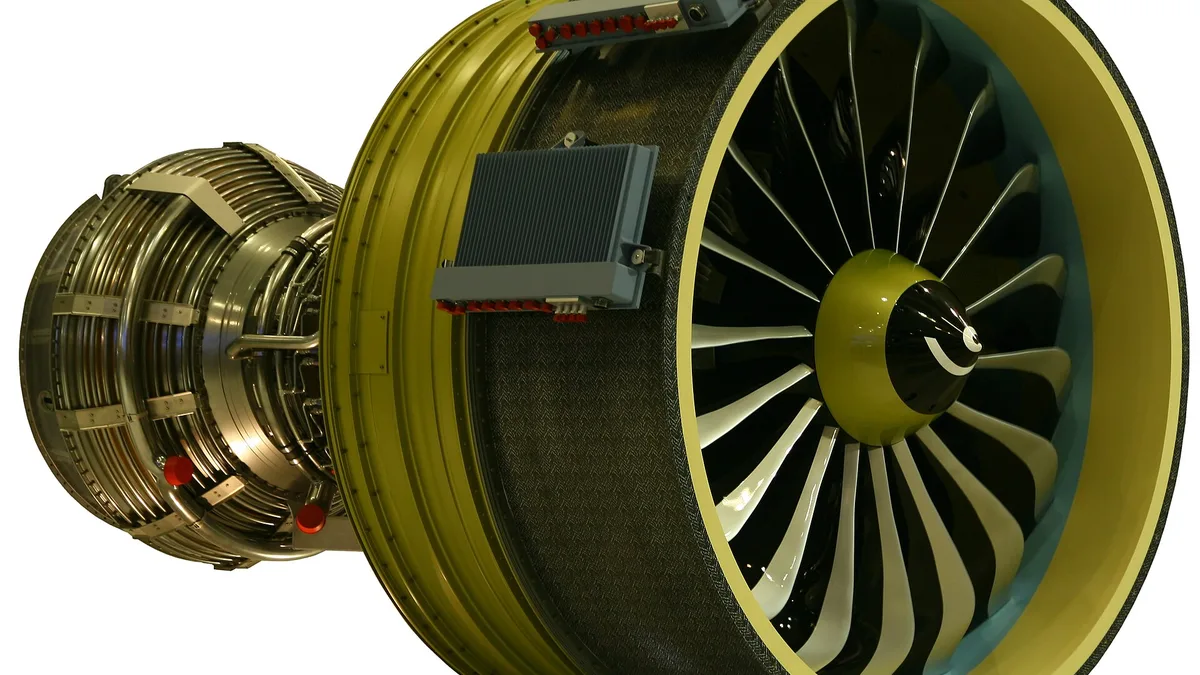
Cfm Leap 1B
| Aircraft application | Boeing 737 MAX 7, MAX 8, MAX 9, MAX 10 |
|---|---|
| Thrust range | 23,000 to 28,000 lbf |
| Programme status | In production, in service |
| Original use | Commercial narrow-body aircraft propulsion |
| Bypass ratio | High (approximately 9:1) |
| Configuration | Twin-spool, axial flow, high-bypass turbofan |
Origin and history
The CFM International LEAP-1B is a high-bypass turbofan aircraft engine developed through a joint venture between American company GE Aerospace and French company Safran Aircraft Engines. This partnership, named CFM International, was established in the 1970s and has its roots in the successful CFM56 engine family. The LEAP engine program was officially launched in the 2000s, with the LEAP-1B variant being developed specifically for a single airframe. The engine represents a direct successor to the CFM56 series, incorporating significant technological advancements aimed at improving efficiency and reducing emissions. Its development was driven by the aviation industry's push for next-generation, more sustainable propulsion systems in the early 21st century. The LEAP-1B entered into service in the 2010s, marking a new chapter for the long-standing CFM partnership.
What it is designed for
The LEAP-1B is designed exclusively as the sole powerplant for the Boeing 737 MAX family of narrow-body airliners. Its primary design objectives are to provide double-digit percentage improvements in fuel burn and carbon dioxide emissions compared to the previous-generation CFM56-7B engine used on the 737 Next Generation series. The engine is engineered to deliver lower operating costs for airlines through this enhanced fuel efficiency and improved maintenance intervals. A key design constraint was fitting the engine to the 737's relatively low-slung airframe, which required specific architectural choices not found on other LEAP variants. It is built to meet stringent modern noise regulations, significantly reducing the noise footprint compared to earlier engines. The design also incorporates advanced materials and cooling techniques to allow for higher operating temperatures and pressures, which are fundamental to its efficiency gains.
Development and versions
The LEAP-1B was developed in parallel with two other core variants, the LEAP-1A for the Airbus A320neo family and the LEAP-1C for the COMAC C919. Its development was heavily influenced by the need to maintain commonality with the 737's existing pylon and landing gear geometry, leading to a distinct fan size and nacelle design. A major focus was integrating technologies from GE's GEnx program and Safran's research, including the use of three-dimensional woven carbon fiber composite fan blades and a fan case. The engine features a twin-annular pre-swirl (TAPS II) combustor designed to reduce nitrogen oxide emissions. Throughout its development, the program encountered challenges related to the durability of certain components in the high-pressure turbine section, leading to service bulletins and design refinements. As of its entry into service, the LEAP-1B has been produced in progressively updated production standards, often referred to as "configurations," which incorporate minor reliability and durability improvements, but it does not have separate, distinct model sub-variants like the -1A has.
Pros and cons
A primary advantage of the LEAP-1B is its substantial reduction in fuel consumption, which directly translates to lower operating costs and reduced carbon emissions for airlines. The engine is also significantly quieter than its predecessor, benefiting communities near airports and helping airlines comply with noise restrictions. Its use of composite materials and ceramic matrix composites in the hot section contributes to weight savings and improved thermal efficiency. A significant con is its higher maintenance complexity and cost compared to the older CFM56, particularly for repairs involving the advanced composite fan blades or the ceramic matrix composite components in the turbine. Operators have reported issues with premature wear of certain high-pressure turbine parts and carbon seal concerns, leading to unscheduled shop visits that disrupt fleet planning. The engine's reliance on sophisticated full-authority digital engine control (FADEC) software and extensive sensor suites can also lead to operational delays from software-related caution messages or sensor faults, which are less common on older, more mechanically simple engines.
Who it suits
The LEAP-1B suits airlines operating the Boeing 737 MAX family who prioritize fuel efficiency on high-utilization, short-to-medium-haul routes where even small fuel savings compound significantly. It is a necessary choice for any operator of the 737 MAX, as it is the only engine option available for that airframe, locking those customers into CFM International's product support network. The engine is well-suited for carriers with modern, technically advanced maintenance departments capable of handling its composite repair techniques and complex diagnostic systems. It is less suited for airlines operating in regions with limited access to CFM's specialized technical support or for those with a fleet strategy centered on older, fully depreciated aircraft where lowest possible maintenance cost is the absolute priority. Airlines that highly value commonality with existing CFM56 fleets will find some benefits in certain support systems, but must also accept the new maintenance realities of a more technologically advanced powerplant.
Latest Cfm Leap 1B news
Latest reporting

PT9 turboprop engine certified with 33% more power and 20% lower fuel burn
Pratt & Whitney Canada's new PT9 turboprop engine, targeting the 1,700-2,300 shp class, received Transport Canada certification on October 1, 2026...

Turkish Airlines Signs CFM MOU for 600+ LEAP-1B Engine Support
Turkish Airlines has signed a Memorandum of Understanding with CFM International for long-term service support covering over 600 LEAP-1B engines and...