Boeing 777X Breaks Taboo with Folding Wingtips
Boeing's 777X introduces the first folding wingtips on a commercial airliner, a design avoided for decades due to weight and complexity.
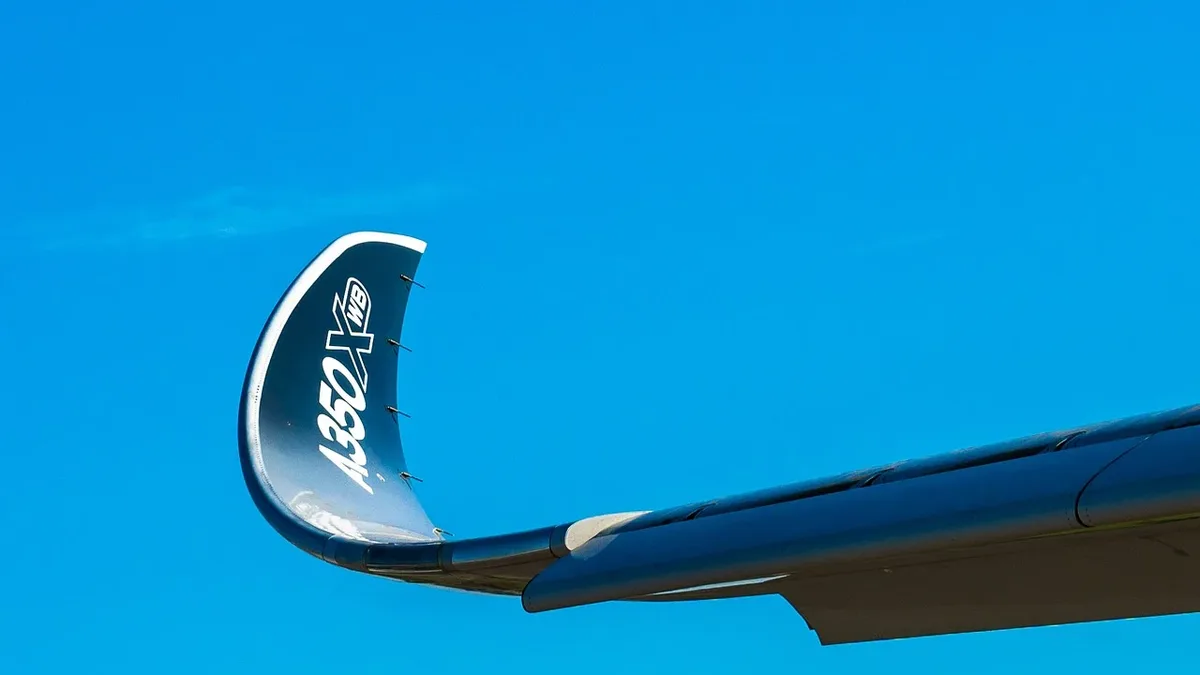
Boeing has broken a long-standing design taboo in civil aviation by introducing hinged, folding wingtips on its new 777X widebody airliner. The radical feature allows the aircraft to shrink its wingspan for airport gates while maintaining an ultra-efficient, high-aspect-ratio wing for flight.
The industry avoided such designs for decades following a failed 1990s concept. Now, material science and new regulatory frameworks have made the folding wing a commercial reality on the 777-9 and 777-8 variants.
A Concept Rejected in the 1990s
The commercial aviation industry largely avoided folding wings because of a failed gamble during the original Boeing 777-200 development program in 1990. Boeing had patented and offered an optional 21-foot folding wingtip mechanism. It was designed to fit the widebody into older airport gates built for aircraft like the DC-10.
The operational reality created an unacceptable trade-off. Placing the fold line mid-wing cut through active flight control surfaces and hydraulic lines. This added significant weight and sacrificed internal wing fuel capacity. Carrying this dead weight on every flight burned more fuel over the aircraft's lifecycle than the gate flexibility was worth. Every launch customer rejected the option.
Airlines concluded it made no financial sense to burn extra fuel for constrained gates when airports could simply adapt. This rejection convinced manufacturers that dynamic wing joints were a commercial dead end.
The Wingspan Dilemma for Jumbos
When Airbus designed the A380 in the late 1990s, it skipped folding wingtips entirely. Its massive 261-foot, 10-inch wingspan forced global airports to adapt, creating the ICAO Code F category. Major hubs spent tens of millions to accommodate it, but only about 140 airports worldwide achieved the necessary certification.
For the 747-8, Boeing stretched the wingspan to 224 feet, 7 inches to stay within Code E limits. However, it realized traditional aluminum-alloy wing designs had hit a wall. Adding more span for efficiency did not work once the structural weight canceled out the fuel savings. Boeing knew any future long-haul twin-jet would need a much higher aspect ratio to hit fuel burn targets without falling into the Code F trap. Solving this required a materials revolution.
Composite Materials Enable the Breakthrough
The breakthrough came with the shift from traditional aluminum to fourth-generation carbon-fiber reinforced polymer (CFRP) wing construction. This allowed Boeing to build a slender, ultra-high-aspect-ratio wing that could flex under load while remaining light. Crucially, it let engineers move the hinge line to the extreme outboard edge.
Moving the fold line past the fuel tanks, slats, and ailerons created a clean, passive aerodynamic extension. Each folding tip measures 11 feet, 4 inches. Fabricated at Boeing's St. Louis Composite Center of Excellence, the hinged tip contains no active control surfaces or fuel lines. Only low-voltage electrical wiring for lights crosses the fold axis.
An electric power drive unit and rotary actuators from Liebherr power the hinge. This reduced the system's weight penalty to a fraction of the 1990s concept. The design allows the 777X to shrink from a 235-foot, 5-inch flight span to a 212-foot, 9-inch ground footprint for Code E gates.
Regulators Draft New Safety Rules
Civil aviation regulations contained no existing airworthiness standards for hinged wingtips. The FAA and EASA had to publish custom Special Conditions. Regulators treated any uncommanded in-flight wingtip motion as a likely catastrophic event. Boeing had to prove that no single failure, or combination of failures, could cause the tips to unlock while airborne.
To satisfy this, Boeing engineered a triply-redundant locking architecture with mechanical primary latch pins, secondary locking keys, and electric lock actuators. The FAA mandated 10 specific Special Conditions. These require the wingtips to withstand ground gusts up to 65 knots while folded and handle severe icing along the hinge line.
A critical safety logic removes all electrical power to the folding actuators once the aircraft accelerates on the takeoff roll. Movement is rendered mechanically impossible until the jet lands and decelerates below 50 knots. This eliminates airborne risk but transfers operational vulnerability to airport ramps. If a sensor fails to verify a lock is engaged at the runway holding point, flight computers inhibit takeoff thrust, potentially forcing a return to the gate.
Evaluating the Trade-Offs
For airlines, the 777X presents a clear trade-off. A 10% reduction in fuel burn per seat is weighed against the added capital cost, system weight, and maintenance overhead of the dynamic joints. On an ultra-long-haul route like Dubai to Los Angeles, spanning over 8,000 nautical miles, trimming a tenth of fuel consumption saves thousands of gallons per flight.
Offsetting that gain is the weight of the Liebherr drive assemblies and added maintenance for actuators, locking pins, and hinge seals over a 20-year lifecycle. Beyond the immediate balance sheet for the 777-9 and 777-8, Boeing's folding wingtip establishes a proof of concept for future designs.
Manufacturers aiming for aspect ratios of 15 or higher to meet net-zero carbon targets will see fixed wingspans exceed 250 feet. This will make ground folding systems mandatory. Lessons from the 777X are already informing studies for Transonic Truss-Braced Wing designs and future blended-wing-body transports, where flexible wing extremities must adapt between airport aprons and high-altitude cruise.