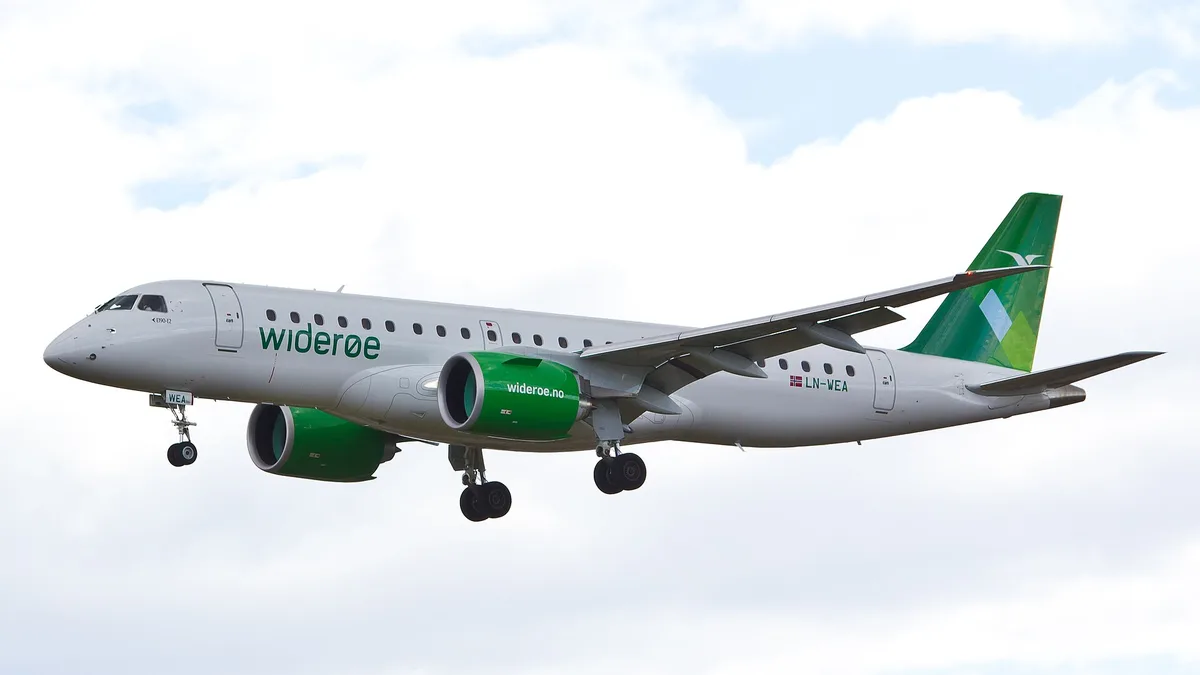
Embraer E195 E2
| Manufacturer | Embraer |
|---|---|
| Country of origin | Brazil |
| First flight | 2019 |
| Original use | Commercial regional jet |
| Seating capacity (typical two-class) | 120 to 146 |
| Engines | 2 × Pratt & Whitney PW1900G |
| Maximum takeoff weight | 61,500 kg |
| Wingspan | 35.1 m |
Origin and history
The Embraer E195 E2 originates from Brazil, developed by the aerospace manufacturer Embraer. Its development was publicly launched in the 2010s as part of the second generation of the E-Jet family. This programme, known as the E-Jet E2 series, was a strategic response to evolving market demands for greater efficiency and performance. The E195 E2 is the largest variant within this new generation, designed to succeed the first-generation E195. Its development followed the successful establishment of the original E-Jet family in the 2000s, which positioned Embraer as a leading manufacturer in the regional and narrow-body jet segment. The E195 E2 first flew in the late 2010s, marking a significant milestone for the company's commercial aviation portfolio.
What it is designed for
The Embraer E195 E2 is designed as a narrow-body jet airliner for regional and short-to-medium-haul routes. Its primary design goal is to offer superior fuel efficiency and lower operating costs compared to previous generation aircraft in its class. The aircraft is engineered to serve routes that have passenger demand which is too high for smaller regional jets but insufficient to efficiently fill larger single-aisle aircraft like the Airbus A320neo or Boeing 737 MAX. It enables airlines to increase frequency on existing routes or profitably open new thinner routes with better gauge. The cabin is designed to provide a single-class layout for up to 146 passengers in a typical high-density configuration, focusing on passenger comfort with modern amenities. The design philosophy centers on providing an economically optimal aircraft for markets where capacity and range requirements sit between traditional regional jets and larger mainline narrow-bodies.
Development and versions
The development of the E195 E2 was part of a clean-sheet redesign of the Embraer E-Jet platform, despite retaining the original family's cross-section. Key developments included new, more efficient Pratt & Whitney PW1900G geared turbofan engines and a completely new, longer composite wing with increased span and raked wingtips. The aircraft also features a new fly-by-wire flight control system and updated avionics in the cockpit. The E195 E2 is one of three variants in the E2 family, alongside the smaller E175 E2 and the E190 E2. It differs from its siblings primarily in its fuselage length, being the longest, and its maximum seating capacity. No sub-versions of the E195 E2 itself have been developed, as it represents the maximum stretch of the airframe platform within this generation.
Pros and cons
A primary advantage of the E195 E2 is its exceptional fuel efficiency per seat, derived from its advanced engines and aerodynamic wing, which significantly reduces direct operating costs for airlines. The cabin, while narrower than competing Airbus and Boeing aircraft, is designed with a two-by-two seating layout that eliminates the less popular middle seat, enhancing passenger appeal. Commonality with the other E2 variants offers operational and training benefits for fleets that operate multiple models. A significant con is its high acquisition cost relative to some older-generation, used aircraft, which can be a barrier for carriers with strict capital constraints. The aircraft's performance can be compromised on very short runways or at high-altitude airports when operated at its maximum payload, requiring careful route planning. Some airlines regret the choice if their network evolves to require consistently higher capacity, as the aircraft's size ceiling is fixed, potentially leading to fleet fragmentation or premature replacement.
Who it suits
The Embraer E195 E2 ideally suits airlines operating dense regional networks or those looking to up-gauge from smaller regional jets without jumping to a 180-seat aircraft. It is a strong fit for full-service carriers that need a cost-effective aircraft for thin, long-range regional routes or for building frequency on hub-feeder services. Low-cost carriers focusing on point-to-point markets with moderate demand also find it suitable for maintaining high load factors and frequency. Airlines with existing Embraer E-Jet fleets, particularly first-generation E190/E195 operators, are natural candidates, as the E2 offers a logical, efficient replacement with crew commonality. It suits markets where passenger volume is growing but remains volatile, allowing for capacity adjustment with lower financial risk than a larger aircraft. Conversely, it is less suited for major network carriers that standardize on larger narrow-body families for simplicity, or for airlines whose primary airports have restrictive operational limitations that affect the aircraft's full payload-range capability.
Latest Embraer E195 E2 news
Latest reporting

FAA Proposes Certification for Embraer E195-E2 Automated Takeoff
The FAA has proposed special certification criteria for Embraer's Enhanced Takeoff System on the E195-E2 jet, aiming to address safety for automated...

Japan Airlines orders Embraer E190-E2 for J-AIR fleet renewal
Japan Airlines has selected up to 26 Embraer E190-E2 jets to replace J-AIR's existing regional fleet, with deliveries starting in fiscal 2029.
BermudAir leases Embraer E190F for cargo service
BermudAir has leased an Embraer E190F freighter from Regional One to move express cargo across its existing network.

Embraer Delivers 2,000th E-Jet to Azul
Embraer has delivered its 2,000th E-Jet, an E195-E2, to Brazilian airline Azul. The milestone places the E-Jet family among the world's three most...

Airlink E-Jets' 50-Foot Stadium Flyover
Two Airlink Embraer jets performed an extremely low flyover of Cape Town's DHL Stadium on Saturday.