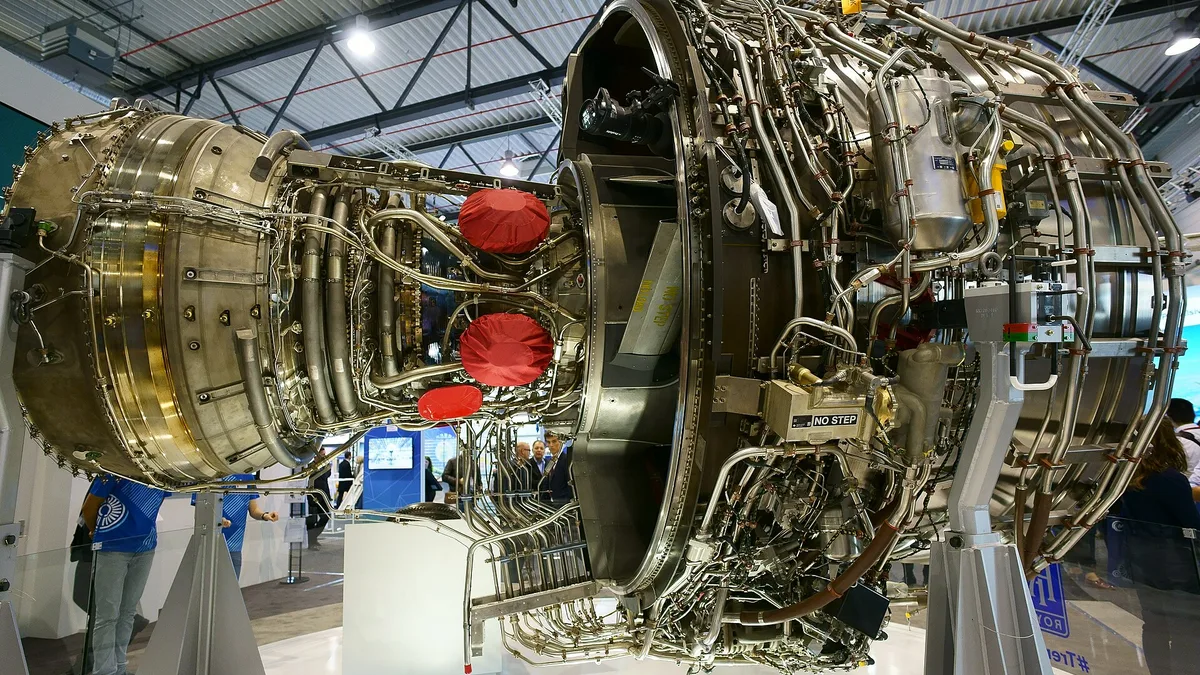
Rolls Royce Trent Xwb
| Aircraft type | Airbus A350 |
|---|---|
| Manufacturer | Rolls-Royce plc |
| Original use | High-bypass turbofan for long-haul commercial flight |
| Thrust class | 74,000–97,000 lbf |
| Configuration | Twin-spool, high-bypass |
| Programme status | In production and service |
| First run | 2010 |
Origin and history
The Rolls-Royce Trent XWB is a high-bypass turbofan engine originating from the United Kingdom. It is the latest member of the three-spool Trent engine family, which itself evolved from the earlier RB211 engine line. Development of the Trent XWB was formally launched in the late 2000s to exclusively power a new aircraft model. Its design draws directly on experience from preceding Trent engines, particularly the Trent 1000 and Trent 900, incorporating proven core architecture. The engine was created specifically to meet the demanding requirements of a new generation of long-haul, high-capacity twinjet airliners. Its first run on a test bed occurred in 2010, marking a key milestone in its development history.
What it is designed for
The Trent XWB is designed exclusively as the sole powerplant for the Airbus A350 XWB family of wide-body aircraft. Its primary design goal is to provide the high thrust necessary for long-range operations while delivering significant improvements in fuel efficiency over previous generation engines. The engine is engineered to work in harmony with the A350's advanced composite airframe to optimize overall aircraft performance. A key design focus was achieving a substantial reduction in carbon dioxide emissions per passenger kilometre. It is also designed for enhanced durability and reliability to support extended range operations where diversion airports may be distant. Furthermore, the engine is built to operate more quietly than its predecessors, helping airliners meet stricter community noise regulations around airports.
Development and versions
Development of the Trent XWB involved an extensive testing programme, including ground tests and flight trials on a dedicated Boeing 747 flying testbed. The engine entered service in the 2010s, powering the first delivery of the Airbus A350-900 variant. The initial production version, the Trent XWB-84, was rated at 84,000 pounds of thrust. A more powerful derivative, the Trent XWB-97, was subsequently developed to provide the increased thrust required for the larger, longer-range A350-1000 variant. This version features a larger fan diameter, a modified intermediate pressure compressor, and a more powerful high-pressure system. Continuous development has also led to Package B and Package C upgrades, which introduce incremental improvements in turbine efficiency, aerodynamics, and cooling to reduce fuel burn further.
Pros and cons
A significant pro of the Trent XWB is its demonstrated fuel efficiency, which is a major operational cost saving for airlines and reduces environmental impact. The engine is also noted for its high reliability and low in-flight shutdown rate, contributing to strong dispatch availability for A350 operators. However, a notable con has been issues with the durability of certain turbine components in early service, leading to unscheduled shop visits and increased maintenance costs for some operators. Some airlines have regretted early adoption due to these initial reliability teething problems, which required inspection and retrofit campaigns. A common mistake is underestimating the maintenance complexity and cost associated with its advanced technology and materials, despite its design for easier servicing. Furthermore, as the sole engine option for the A350, airlines have no alternative powerplant choice, which can limit negotiating leverage and create dependency on a single manufacturer's support network.
Who it suits
The Trent XWB suits airlines operating long-haul routes that prioritize fuel efficiency and lower emissions to manage operating costs and environmental targets. It is particularly suited to full-service network carriers and large leasing companies that require the advanced technology and passenger appeal of the Airbus A350 platform. The engine family suits operators of both the A350-900 and the larger A350-1000, as the scaled versions provide commonality benefits in training and maintenance. It is less suited to airlines with limited technical resources or those unwilling to manage the initial higher maintenance costs associated with a new-generation engine. The engine also suits operators flying into noise-sensitive airports, thanks to its quieter acoustic signature. Ultimately, it is an engine for airlines committed to the A350 ecosystem and prepared to invest in the latest propulsion technology for long-term fleet modernization.
Latest Rolls Royce Trent Xwb news
Latest reporting
Rolls-Royce Invests $1 Billion in U.S. Engine Test Facilities
Rolls-Royce has completed a $1 billion upgrade to its Indianapolis facilities, expanding test and manufacturing capacity to support engines for the...

Rolls-Royce Trent 1000 XE Engine Triples Time On Wing
Rolls-Royce says its redesigned Trent 1000 XE engine standard delivers three times the time on wing of the previous TEN model.