Unusual Aircraft Graveyards Hold Aviation History
Beyond typical boneyards, unique sites like a stranded Trident in Cyprus and a lagoon full of WWII warbirds preserve rare chapters of aviation history.
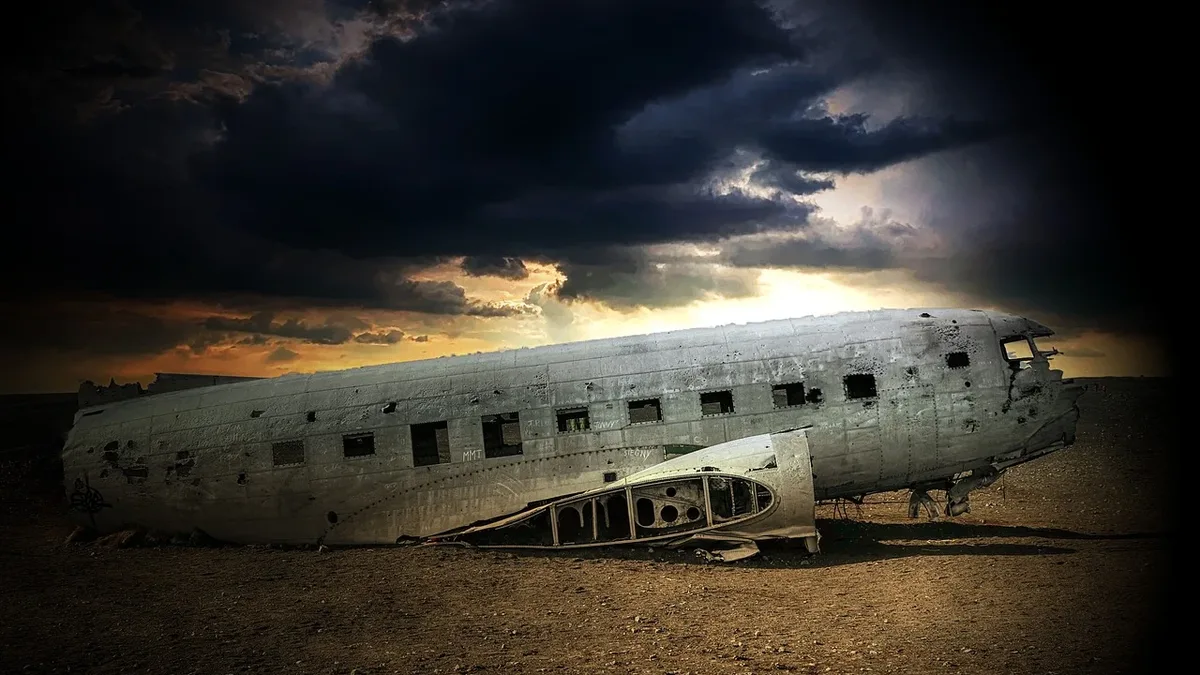
When airliners retire, they typically head to storage facilities known as boneyards. There, parts are salvaged and airframes sit for years. Some of these final resting places hold far more unusual collections than rows of common Airbus and Boeing jets. These sites capture specific moments in history, from Cold War conflicts to airline mergers and postwar disposal.
Nicosia's Stranded Trident
Nicosia International Airport in Cyprus has been closed since the 1974 Turkish invasion. Its last official commercial flights were special ferry operations in 1977. During those flights, three former Cyprus Airways aircraft were retrieved by British Airways engineers and flown to London. A fourth aircraft, a Cyprus Airways Hawker Siddeley Trident 2E, was too damaged to fly out. One of its engines was cannibalized to help another Trident depart. The gutted Trident 2E remains on the airfield today, a solitary relic.
The airport is still under United Nations control, maintaining a buffer zone. The UN even operates helicopters from the site. There have been suggestions to turn the airport and its terminal into a museum, but no concrete plans have materialized. For over fifty years, the lone Trident has been parked, offering a unique, if solitary, graveyard story.
Dunsfold's Film-Star 747s
Dunsfold Aerodrome in Surrey, England, is a former World War II airfield later used by aircraft manufacturers. It is now home to several retired Boeing 747s. One Boeing 747-200 originally flown by British Airways is based there, joined by two former British Airways 747-400s in 2020. The airfield is famously known as the former home of the motoring show Top Gear from 2002 to 2020.
The 747-200 has been used as a film prop. A second 747 was also used for productions before being broken up. The third 747, painted in British Airways' historic 'Landor' livery, is intended for preservation as a local landmark. However, Dunsfold's days are numbered. Local governments have approved plans to demolish the airfield and redevelop the land for housing.
Zhukovsky's Military Secrets
Zhukovsky International Airport, southeast of Moscow, doubles as a storage site for retired Russian military aircraft. Little is officially published about this graveyard, with insights coming from satellite photos and visitor accounts. The site has hosted a wide array of retired equipment.
The area is owned by the Gromov Flight Research Institute and is a secure testing facility. Public access has been limited to events like the MAKS airshow, which hasn't been held since 2021. With Russia's increased isolation, recent details are scarce, leaving satellite imagery as the primary source of information.
Laurinburg-Maxton's Northwest Time Capsule
Laurinburg-Maxton Airport in North Carolina hosts a facility run by Charlotte Aircraft, a company that dismantles airliners for parts. What makes it notable is its high concentration of former Northwest Airlines aircraft. Northwest merged with Delta Air Lines over 16 years ago, making its livery a rarity.
Many of the stored planes are Boeing 727s and DC-10s, types that are essentially retired from service, along with some 747s. Strikingly, most wear Northwest's distinctive 1989 'Bowling Shoe' livery rather than the carrier's final 2003 design. The aircraft are in various states of disassembly. This site provided the forward fuselage of Northwest's first 747-100 to the National Air and Space Museum for display. A former Delta 747-400, inherited from Northwest, is also stored there.
Kwajalein's Lagoon of Warbirds
Following World War II, the United States faced a surplus of hundreds of warplanes in the Pacific. With limited ship space to bring them home and a priority on returning personnel, the military chose a drastic disposal method. Near Kwajalein Atoll in the Marshall Islands, aircraft were loaded onto barges and dumped into the lagoon.
It is estimated the United States disposed of roughly 150 warplanes this way. These planes were not combat losses but deliberately discarded, so many remain fairly intact on the seabed. Over eighty years later, they have been taken over by coral growth, creating an underwater aircraft graveyard from the final days of the war.