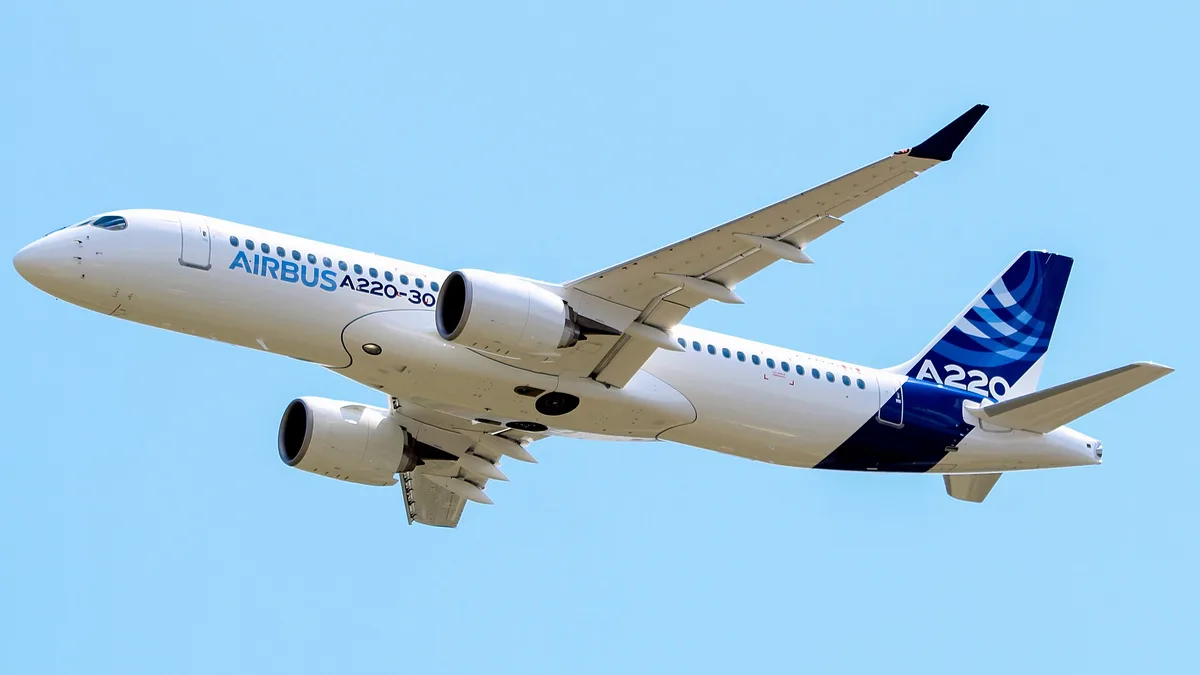
A220
| Country of origin | Canada (final assembly), multinational consortium |
|---|---|
| First created | First flight in 2013, entered service in 2016 |
| Original use | Commercial narrow-body passenger airliner |
| Manufacturer | Airbus (originally developed by Bombardier as the CSeries) |
| Seating capacity | 100 to 150 passengers (typical two-class configuration) |
| Range | Approximately 3,400 to 3,600 nautical miles |
| Engine type | Two Pratt & Whitney PW1500G geared turbofan engines |
Origin and history
The Airbus A220 originated as the Bombardier CSeries, a clean-sheet aircraft program developed by the Canadian manufacturer Bombardier Aerospace. Its development was launched in the 2000s, with the program officially unveiled at the Farnborough Air Show in 2008. The first flight of the initial variant, the CS100, occurred in 2013, marking a significant milestone for the new narrowbody jet. Facing severe financial pressure and trade disputes, Bombardier sold a controlling stake in the program to Airbus in 2017. Airbus rebranded the aircraft family as the A220 in 2018, integrating it into its product lineup. Production and final assembly occur at facilities in Mirabel, Canada, and Mobile, USA, with major components like the wing manufactured in Northern Ireland.
What it is designed for
The A220 is specifically designed as a small, single-aisle, twin-engine jet airliner to serve the 100-150 seat market segment with high efficiency. It targets routes that are too thin for larger narrowbodies like the A320neo or Boeing 737 MAX but are inefficient for older regional jets. The design prioritizes exceptional fuel efficiency and low operating costs on short- and medium-haul routes, enabling profitable service on thinner, point-to-point city pairs. Its cabin is engineered to offer a passenger experience competitive with larger aircraft, featuring wide seats, large windows, and improved cabin altitude and humidity. Airlines utilize the A220 to open new routes, replace aging fleets of smaller jets, and provide mainline service on routes previously operated by regional partners. The aircraft's range also allows for transcontinental flights, providing network flexibility.
Development and versions
The program developed two main variants, originally designated the CS100 and the larger CS300. Following the Airbus acquisition, these were renamed the A220-100 and A220-300, respectively. The A220-100 is the base model, typically seating 100-120 passengers in a two-class configuration, and was the first to enter service with Swiss Global Air Lines in 2016. The A220-300 is the stretched-fuselage variant, offering more capacity at 120-150 seats and becoming the more popular model due to its superior per-seat economics. Both variants share commonality in pilot type rating, maintenance, and spare parts, featuring the same advanced Pratt & Whitney PW1500G geared turbofan engines and similar flight decks. Ongoing development focuses on incremental improvements, including potential future increases to maximum takeoff weight for greater range or payload.
A220 specs
The A220 features an advanced aluminum alloy and composite material airframe, with composites used extensively in the wings and empennage for weight reduction. It is powered by two Pratt & Whitney PW1500G geared turbofan engines, which are central to its fuel efficiency and noise reduction claims. The aircraft has a fly-by-wire flight control system and a modern cockpit with large display screens common to newer Airbus aircraft. The A220-300 has a longer fuselage and higher maximum takeoff weight compared to the -100, translating directly into greater range and payload capability. Its wingspan is notably large for its fuselage length, contributing to excellent aerodynamic efficiency and fuel performance. Cabin cross-section is wider than previous generation aircraft in its class, allowing for wider economy seats and broader aisles.
A220 seat map
A typical two-class A220 cabin features a spacious forward section for business or premium economy seating, often configured with four seats per row in a 2-2 layout. The larger economy cabin is most commonly arranged with five seats per row in a 3-2 configuration, which avoids the typical narrowbody middle seat by having a pair of seats on one side. This 3-2 layout is a key passenger-friendly differentiator, as no passenger is ever more than one seat from an aisle. Seat pitch and specific cabin layouts, including the number of rows for each class, are determined by the individual airline customer and can vary significantly. Some airlines opt for a higher-density all-economy layout, which may use a 2-3 configuration to maximize capacity while retaining the single-aisle access benefit. Galley and lavatory positions are typically located at the front and rear of the cabin, with additional mid-cabin lavatories on longer-range configurations.
Overview
The Airbus A220 represents a modern, purpose-built solution for the lower-capacity end of the mainline jet market, filling a distinct niche. It combines advanced aerodynamics, efficient geared turbofan engines, and a lightweight structure to achieve significant operational cost advantages. The aircraft family has been well-received by airlines for its economics and by passengers for its comfortable, quiet cabin environment. Since its integration into the Airbus portfolio, the program has gained greater sales momentum and global recognition, securing orders from major carriers worldwide. It competes directly with smaller variants of the Boeing 737 MAX and the Embraer E-Jet E2 family, against which it offers a larger cabin cross-section. The program's future is now tied to Airbus's ability to ramp up production rates and potentially develop further derivatives to expand its market reach.
What to know
The A220's entry into service was not without challenges, including early technical issues with the Pratt & Whitney engines that required software updates and hardware modifications for reliability. Its development and production history is complex, involving a multinational supply chain and a contentious trade dispute that preceded the Airbus takeover. While offering excellent economics, the aircraft's acquisition cost is understood to be higher than some competing models, a factor airlines weigh against its lower operating costs. Commonality with other Airbus aircraft is primarily at the cockpit systems level, as the airframe and engines are unique within the Airbus family, limiting some synergies. Airlines must consider the current production ramp-up and global support network, which, while growing, is not as extensive as that for the established A320 family. The aircraft's performance in hot and high altitude airports is considered a strength, making it suitable for operations in challenging environments.
Common questions
A common question is whether the A220 is a true Airbus aircraft, given its origin as the Bombardier CSeries; it is now fully integrated into Airbus's product line and sales, marketing, and support structures. Many ask about its range, which is sufficient for transcontinental routes in North America and many long thin international routes, such as across Europe or to leisure destinations. Passengers frequently inquire about the seating configuration, specifically the 3-2 economy layout that eliminates the standard middle seat cluster found on larger narrowbodies. A recurring operational question concerns engine reliability, which has seen substantial improvement since initial service entry through ongoing product maturation and updates. Airlines and analysts often compare it directly to the Embraer E195-E2, as both target the same seat capacity with different design philosophies regarding fuselage cross-section and engine choice. Another frequent topic is future development, with industry discussion focusing on potential stretches, range increases, or a freighter variant, though Airbus has not officially launched such projects.
Pros and cons
Pros include class-leading fuel efficiency per seat, a passenger-preferred 3-2 economy cabin that feels spacious, and low noise levels both inside the cabin and for communities. The aircraft's range and hot-and-high performance unlock route opportunities that are not economically viable with older or larger aircraft, enabling network growth. Its modern systems and design result in high dispatch reliability once initial teething issues are resolved, and it offers a comfortable working environment for flight crews. Cons historically included persistent early issues with the Pratt & Whitney GTF engines, involving unscheduled removals and maintenance directives that affected operational reliability for launch operators. The aircraft's higher initial purchase price compared to some competitors can be a barrier for airlines with strict capital cost constraints, despite lower operating costs. Some airlines regret the limited commonality with the larger A320 family, as it requires separate pilot pools, spare parts inventory, and maintenance procedures, increasing complexity for mixed fleets. A common mistake is underestimating the logistical challenge of supporting a new aircraft type within an existing fleet that lacks family commonality, leading to higher than anticipated transition costs.
Who it suits
The A220 ideally suits network carriers looking to replace aging fleets of smaller 100-seat class aircraft like the Boeing 717 or older Airbus A319s with a far more efficient modern jet. It is an excellent choice for airlines focused on point-to-point routes, including leisure carriers, as it can profitably serve thinner, longer routes with lower demand. Airlines operating in noise-sensitive or environmentally constrained airports benefit from its quiet engines and reduced emissions profile, aiding in slot acquisition and community relations. It suits carriers that prioritize passenger experience as a competitive differentiator, as the cabin comfort is a notable selling point against rival aircraft. The aircraft is also a strong fit for airlines seeking to rationalize their regional jet operations by up-gauging to a mainline aircraft, often improving crew utilization and contract terms. Finally, it suits Airbus customers who want to cover the lower end of the narrowbody market with a product that has strategic support from the manufacturer, despite the lack of full fleet commonality.
Latest A220 news
Latest reporting
Airbus A220's Hybrid Fly-By-Wire System Blends Airbus
The Airbus A220's unique fly-by-wire system, designed by Bombardier before Airbus took over the program, combines Airbus-style sidestick controls with
Delta Airbus A220s Divert After Cabin Fume Incidents
Two Delta Air Lines Airbus A220 flights declared emergencies within 48 hours due to cabin fumes, prompting a diversion and a post-landing aircraft...